
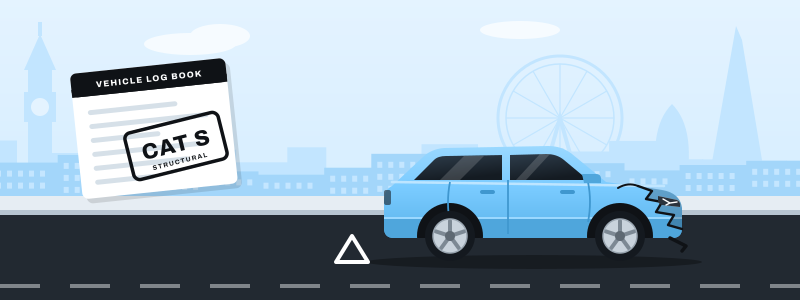
When a car is badly damaged, the insurer decides whether it is worth repairing. If it is not, the car is "written off" and given a category that follows it for life.
Some written-off cars are crushed. Others are repaired and sold again, sometimes without the buyer knowing. The category tells you which, and how serious the damage was.
The four categories
Back on the road: never
Back on the road: never
Back on the road: yes, once repaired to a roadworthy standard
Back on the road: yes, once repaired to a roadworthy standard
Category descriptions from GOV.UK.
Cat S versus Cat N
The difference is the type of damage, not the cost. Cat S means the car's structure was damaged: the chassis, the frame or the parts designed to crumple in a crash. Cat N means the damage was elsewhere, such as body panels, lights or electrics. A Cat N car can have needed expensive repairs, and a Cat S car can have had a small but structural knock. The category alone does not tell you how well it was fixed.
Should you buy a written-off car?
It can make sense. Written-off cars usually sell well below the price of an equivalent car with a clean history, and a well-repaired Cat N car can be a perfectly good car. But go in knowing the trade-offs.
The price stays lower when you sell
The discount you get works against you later: the next buyer will want the same discount. That is fine if you plan to keep the car for years.
Insurance can be harder
Some insurers will not cover written-off cars, and others charge more. You must declare the category, so get quotes before you buy.
The repair is what matters
Ask who repaired the car and how, and for photos and receipts. For Cat S especially, have it inspected by an independent mechanic, ideally one who can check the structure and alignment. Walk away from a seller who cannot or will not explain the repair.
How to find out if a car has been written off
This is where free checks run out. MOT records show how a car has held up at its tests, but they do not record insurance write-offs. Neither does our free MOT history check, and we would rather tell you that than let you assume otherwise.
Insurers record write-offs on an industry database, and paid vehicle history checks search it, along with outstanding finance and stolen-vehicle markers. On any car you are serious about, a paid check is worth the money. Use our free check first to rule out cars with a poor MOT record or suspicious mileage, then pay to check the one you want to buy.
If your own car is written off and you keep it, there are steps you must take with DVLA. GOV.UK explains what to do, and you can be fined up to £1,000 if you do not tell them.
Common questions
Is it legal to drive a Cat S or Cat N car?
Yes, once it has been repaired to a roadworthy standard. It needs a valid MOT, tax and insurance like any other car, and you must tell your insurer about its write-off history.
Does the log book show a car was written off?
For Cat S, yes: if the owner keeps the car, DVLA records the category in the log book. For Cat N, the owner keeps the existing log book, so it may not say anything. That is why a paid history check is the reliable way to find out.
Is a Cat N car cheaper to insure?
Usually not. Some insurers will not cover written-off cars at all, and others charge more. Get insurance quotes before you buy, not after.
What were Cat C and Cat D?
The older repairable categories, used until October 2017. They were based on how much the repairs would cost rather than the type of damage. Cat S and Cat N replaced them, so you may still see C and D on older adverts.