
Buying a used car is a trade between two things that move in opposite directions. The older the car, the less it costs. The older the car, the more likely it is to need work.
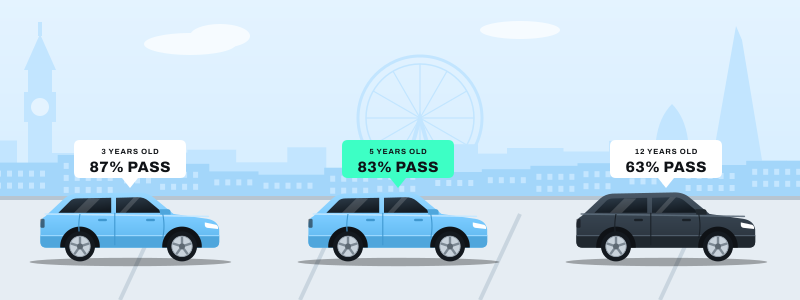
The price side is well known: a car loses most of its value in its first few years. The reliability side is harder to see, so we measured it. Here is the share of cars passing their MOT first time at each age, from 33,060,042 car MOTs in 2024.
MOT pass rate by age
First-time MOT pass rate by vehicle age, cars, 2024. Cars do not need an MOT until they are three. Source: DVSA MOT test data.
Where it falls fastest
The pass rate holds up well to about six years old, then slides. Between seven and twelve it falls from 78% to 62.9%, about 3 points a year. The single biggest drop comes at 9 years old, down 3.4 points on the year before. That is when the expensive wear items, suspension and brakes especially, tend to arrive together.
Why very old cars look better
The pass rate bottoms out at about 56.3% around 18 years old, then rises. That is not old cars getting better. The cars still being tested at twenty are the survivors, usually cherished and lightly used. Do not read it as a reason to buy an old car.
Which age suits you
Three years old: the safest bet
The most reliable used buy, often with some manufacturer warranty left. You pay for it: prices are at their highest for a used car.
Four to six years old: the sweet spot
Pass rates are still above 80%, and the car is past its steepest value loss. For most people buying with their own money, this is where the best value sits.
Seven to twelve years old: choose carefully
Cheaper, but by ten years old roughly one in three does not pass its MOT first time. Pick a model with a strong record at that age, insist on history, and keep some money aside for repairs.
Older than that: buy the car, not the age
At this age the individual car's condition and history matter far more than any average. Have it inspected, read every past MOT, and be ready to walk away.
The model matters as much as the age
These are averages across every car. Some models hold up far better than others, and a good eight-year-old car can beat a poor five-year-old one. See how each model does as it ages on our car reliability pages, compare the most reliable cars, and check the exact car with a free MOT history check.
Common questions
Is a three-year-old car the best buy?
It is the most reliable used buy on our numbers, with 87.3% passing their first MOT. But three-year-old cars carry the highest used prices too, because most of the early value loss has only just happened. Four to six years old usually gives a better balance of price and reliability.
Is a 10-year-old car worth buying?
It can be, if you buy the right example. At ten years old 68.1% pass their MOT first time, so roughly one in three needs work. Pick a model with a good record at that age, check its MOT history, and budget for repairs.
Why do older cars seem to get more reliable?
They do not, really. Beyond about 18 years the pass rate rises because the cars still on the road are the survivors: well-kept, often low-mileage cars whose owners care about them. The neglected ones have already been scrapped.
Does the model matter more than the age?
Often, yes. A strong model at eight years old can pass its MOT as often as a weak one at five. Check the specific make, model and year on our car pages before you decide.